
The lights go out. Your refrigerator hums to a stop. Your phone battery is at 12%. If you’ve lived in New York City long enough, you’ve been there. What most people don’t realize is that the risk of being in that situation is growing, not shrinking. Aging infrastructure, increasingly severe storms, and rising energy demand are putting the city’s power grid under stress it hasn’t faced before. A home generator isn’t a luxury for paranoid homeowners; it’s becoming a practical part of emergency planning for anyone who wants to protect their family, property, and peace of mind.
The NYC Power Grid: A Growing Vulnerability
New York City’s electrical system is one of the most complex urban grids in the world and one of its most strained.
According to the New York Independent System Operator (NYISO), New York’s generation fleet is among the oldest in the country. As these generators age, they are experiencing more frequent and longer outages. This isn’t a distant problem. The 2024 Reliability Needs Assessment identified reliability needs within Zone J, New York City, starting as early as summer 2025, meaning resource margins between supply and demand become dangerously slim, increasing the likelihood of outages.
The numbers tell the story clearly: the potential shortfall will be as much as 446 megawatts, equivalent to 400,000 homes’ worth of electricity demand exceeding the available supply. And that will be the case just in normal summer weather. The shortfall worsens during a heat wave, which increases demand.
For NYC homeowners, this isn’t an abstract policy issue. It’s a warning.
When the Lights Really Went Out: Learning from Sandy
No event better illustrates New York City’s vulnerability to power loss than Hurricane Sandy.
Power outages affected nearly 2 million people in New York City during Sandy, while more than 1 million people lost cellphone service. Around 818,000 New Yorkers lost power for 10 days as a result of the storm. In some neighborhoods, the darkness lasted far longer. 34,000 people living in the Rockaways were left without power for weeks when the storm hit in October 2012.
The storm wasn’t just a blackout. It exposed how quickly a loss of electricity becomes a threat to safety, health, and basic survival, no heat, no refrigerated medication, no way to charge a phone to call for help.
And the science suggests this won’t be a once-in-a-generation event. The odds of a 100-year storm hitting New York or Philadelphia could be 50 percent higher in the future, which means more people could be affected by widespread power outages.
Who Is Most at Risk During an Outage?
A power outage is an inconvenience for many, but a genuine emergency for some. The people most at risk include:
- Seniors and individuals with medical needs, those who depend on powered medical equipment, refrigerated medication (like insulin), or temperature-controlled environments
- Families with young children, loss of heat in winter or cooling in summer, become dangerous quickly
- Home-based workers, a prolonged outage can mean lost income and missed deadlines
- Homeowners in flood-prone areas, without power, sump pumps fail, leading to flooding and costly property damage
If any of these describe your household, a backup power solution isn’t optional; it’s essential.
Two Types of Generators: What’s Right for Your Home?
Once you decide a generator makes sense, the next question is: which kind? There are two main options, and the right choice depends on your home, your budget, and your needs.
Standby Generators (Whole-Home Generators)
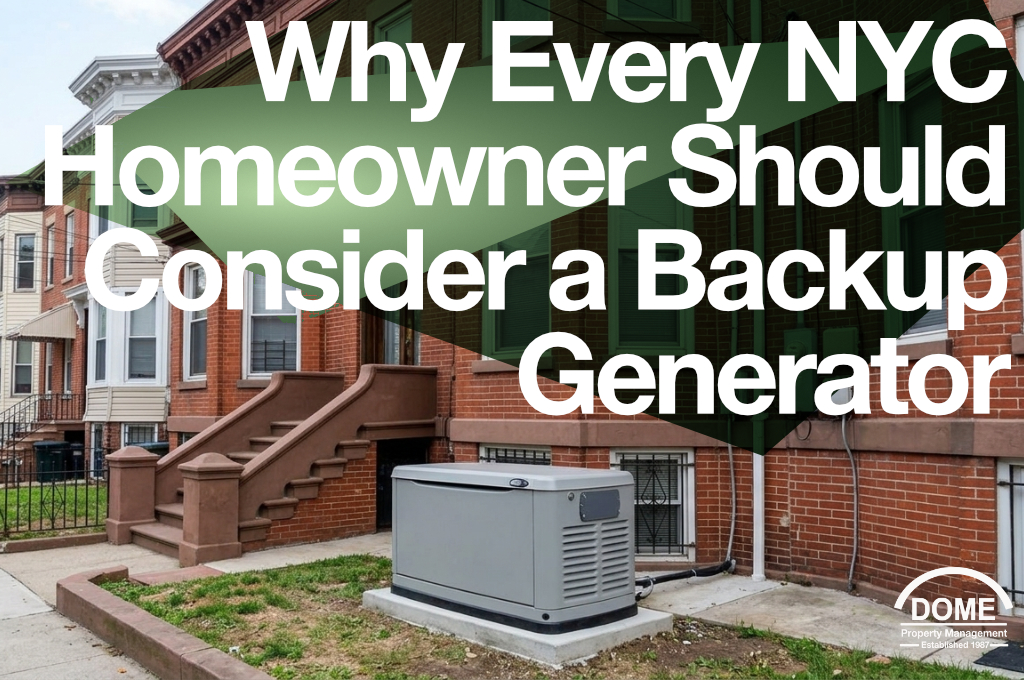
A standby generator is permanently installed outside your home and connected directly to your electrical system. Standby generators are largely worry-free. They’re typically sized to power an entire house and turn on automatically. Propane models can run for days or weeks without refueling, while natural gas models can run indefinitely.
These are often called the “gold standard” of backup power. Experts recommend standby generators over portable generators if homeowners can afford them. Installation typically runs between $10,000 and $14,000 when you factor in the unit, electrical work, and gas line connection, a real investment, but one that can also add value to your property.
Best for: Single-family homeowners in NYC’s outer boroughs with outdoor space, and those who want fully automatic protection.
Portable Generators
Portable generators are much cheaper to buy and install. When a large portable model is connected to your home’s circuit breaker panel with a transfer switch, it can power almost as much as a home standby generator. They typically range from $400 to $2,700.
The tradeoff is convenience and safety. You’ll need to wheel it out, start it manually, and store fuel, and you must always run it outdoors, at least 20 feet from your home, to prevent carbon monoxide poisoning. They’re ideal for smaller homes, condos, and apartments where space and placement might be limited.
Best for: Renters, condo owners, or budget-conscious homeowners who want emergency protection without permanent installation.
Key Questions to Ask Before You Buy
Before making any purchase, ask yourself:
- What do I need to keep running? List your essentials: refrigerator, medical devices, heat/AC, lights, phone chargers. Adding up the wattage helps you size the generator correctly.
- How often do outages happen in my area? Certain regions, including eastern Queens, upper Manhattan, and the Bronx, are more burdened with severe weather-driven outages than other parts of New York City.
- Do I own or rent? Permanent standby generators require professional installation and aren’t suitable for renters.
- What fuel source makes sense? If your home has natural gas service, a standby generator can connect directly. Propane and gasoline are common alternatives.
- What are local codes and restrictions? NYC has specific rules around noise, emissions, and placement. Always check before purchasing.
Safety First: What You Must Know
Generators are powerful tools, and potentially dangerous if misused. Every year, people are hospitalized or killed from carbon monoxide poisoning when generators are run indoors or too close to windows.
Critical safety rules:
- Never run a generator indoors, not in a garage, basement, or enclosed porch
- Keep it at least 20 feet from any window or door
- Install battery-powered carbon monoxide detectors in your home
- Store extra fuel safely and away from the generator
- Have your generator professionally inspected before storm season each year
Is a Generator a Smart Investment for NYC Homeowners?
In short: yes, especially as grid reliability worsens. Beyond emergency preparedness, a properly installed standby generator can increase your home’s resale value, comparable, according to some estimates, to a bathroom remodel. For homeowners managing rental properties or multi-family buildings, maintaining power during an outage can also mean the difference between happy tenants and costly vacancies.
The DOME Connections newsletter put it simply: “Anyone who has wished they had electricity when power wasn’t available would appreciate the value of having a generator.” The question isn’t whether you’ll face an outage in New York City, it’s whether you’ll be ready when you do.
Take Action Before the Next Storm
Emergencies don’t wait for a convenient time. Here’s how to get started today:
- Assess your needs, make a list of everything critical that needs power in your home
- Contact a licensed electrician to discuss standby vs. portable options for your specific property. If you are using natural gas, you will have to hire a licensed plumber also.
- Check NYC building codes and any HOA or condo rules that may affect installation.
- Get at least two quotes from reputable, licensed contractors
- Don’t wait for a storm warning, generators often sell out quickly when a major storm is forecast
Have questions about protecting your property? Contact our property management team to discuss how backup power planning fits into your overall home preparedness strategy.
JUST DEWITT. DOME Property Management has been providing professional property management services to NYC and beyond since 1987. For more information about DOME Property Management and their AI Chatbot Ask The Dewitts, visit DOMEgroup.com or drop us an email at properties@DOMEproperty.com